Essentials
£249/mo
or £199/mo billed annually
compliance, plus automation
Start free →Technology & Threats
Know your exposure to the threats that are active today, and manage the risks that actually affect your business — ranked by what attackers are exploiting, not by raw severity.
786 Cyber maps your digital footprint, prioritises vulnerabilities by real-world exploitability, scans your cloud and web applications, and monitors external threats targeting your organisation — giving you the intelligence to act before attackers do.
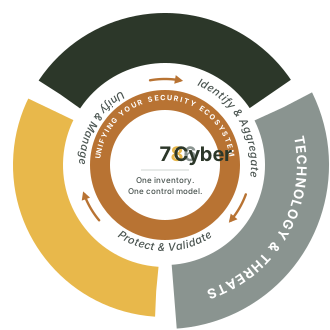
Findings from our scanners and yours — external exposure, web application scans, cloud misconfiguration, internal CVE matching, pen test reports — collected against the same assets.
Every finding validated against NVD, EPSS and CISA KEV, weighted by asset importance and the controls already in place, explained in plain English. Consented active testing when you choose to run it.
One prioritised queue across four posture lanes, each scored on its own terms — never one blended number — with the fix, the owner and the control it affects.
Why visibility matters
The average CVE is exploited in under five days of disclosure. Credentials from old breaches circulate on the dark web long after anyone remembers the account exists. Typosquatted domains impersonate your brand while you're not looking. Technology & Threats is where 786 Cyber closes that visibility gap — across your assets, your cloud accounts, your web applications, your network, and the open internet. Eight capabilities, one posture score, no blind spots you haven't at least been told about.
"The organisations that recover fastest from security incidents are never the ones that were most surprised. They're the ones that had the most visibility — of their assets, their vulnerabilities, and the threats targeting them."
Vulnerability Prioritisation
A CVSS 9.8 that has never been exploited in the wild is less urgent than a CVSS 7.5 sitting on the CISA Known Exploited Vulnerabilities list. Most tools stop at severity, leaving teams triaging hundreds of "critical" findings with no way to tell which five matter this week.
Every finding is scored across four posture lanes — External Domain & IP, Application & Web, Internal Asset and Cloud — into one Technology Posture Score, then ranked by a blended priority combining base severity, real-world exploitability and the criticality of the affected asset. Each finding opens into a plain-English explanation of what it means and what to do, not just a CVE number.
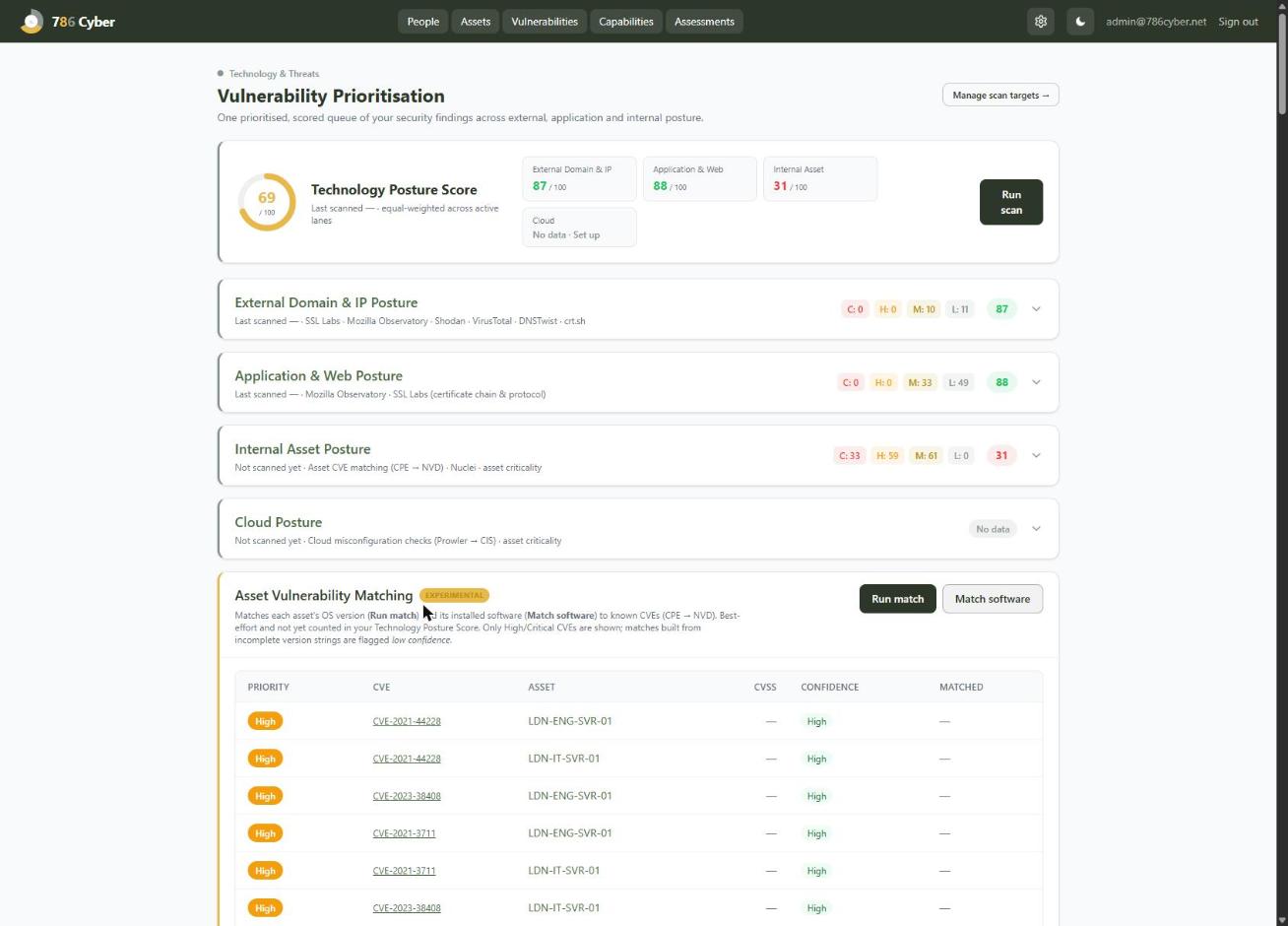
Prioritisation is driven by EPSS (Exploit Prediction Scoring System — the probability a vulnerability will be exploited in the next 30 days) and CISA KEV (the US government’s catalogue of vulnerabilities confirmed as exploited in the wild).
Cloud Security Posture Management (CSPM)
The majority of cloud breaches trace back to misconfiguration, not a novel exploit — an open storage bucket, an over-permissioned IAM role, a security group left wide open. These are invisible to traditional vulnerability scanning because there’s no CVE for "someone left the door unlocked."
Connect an AWS, Azure or GCP account read-only — a small CloudFormation stack creates a SecurityAudit/ViewOnlyAccess role, gated by an ExternalId and revocable in one click — and 786 Cyber runs misconfiguration scanning against CIS Benchmarks, routing findings into the same prioritised queue as every other posture lane.
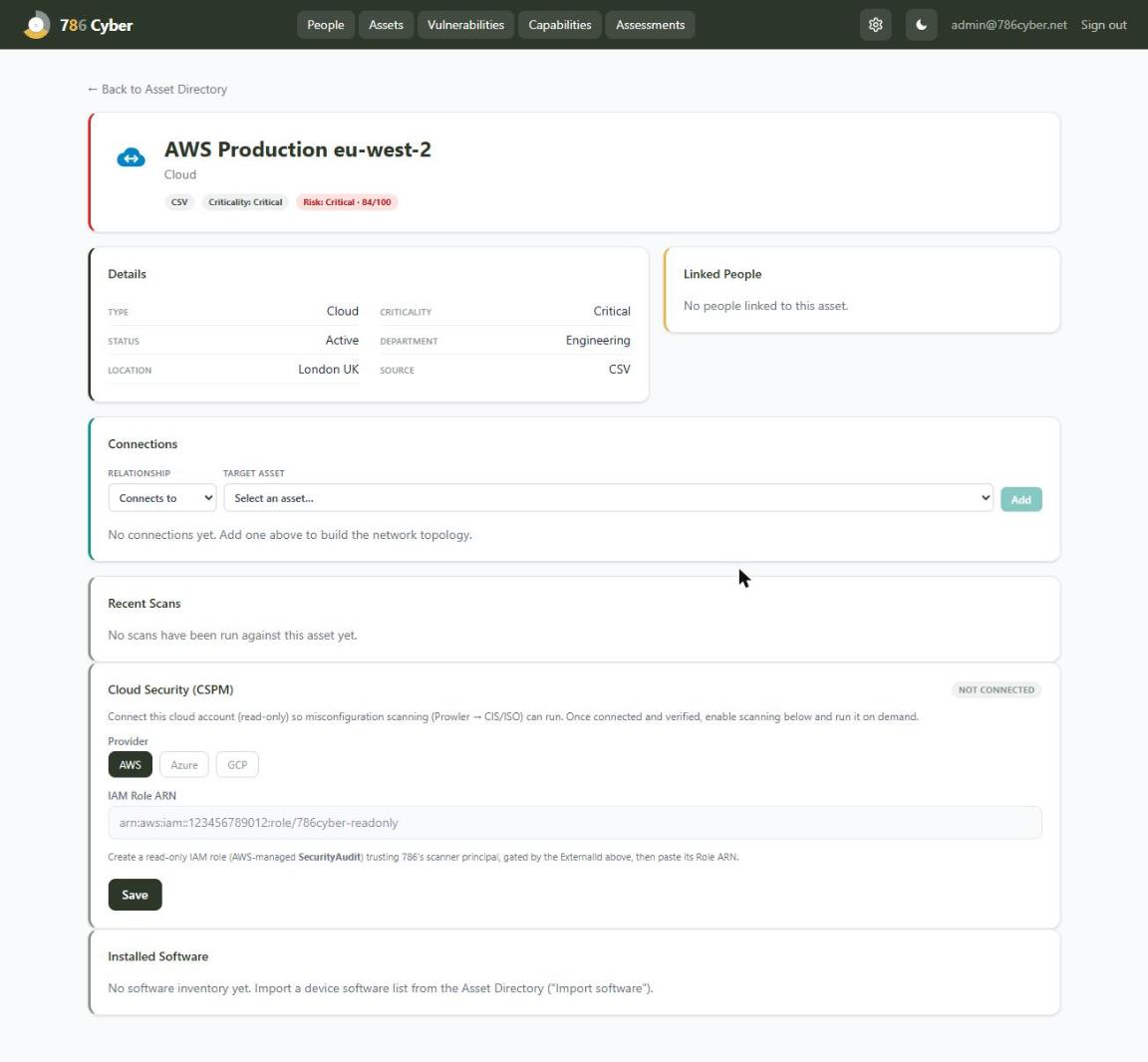
This is CSPM (Cloud Security Posture Management) — automated, continuous checking of cloud configuration against a benchmark, run here via Prowler against CIS and ISO benchmarks. Findings surface as misconfigurations and indicators of exposure, scored and prioritised.
Full feature page →·Docs: cloud connectors →·See it priced →·Talk to us →
Web Application Scanning
Public-facing web applications are the most exposed thing most businesses run, and the most commonly targeted. Missing security headers, weak content policies and clickjacking exposure are all things automated scanners find in minutes — which means attackers find them in minutes too, if you don’t first.
Baseline web application scans run against every domain you register, checking for missing protective headers, content security policy gaps, clickjacking protection and other OWASP-catalogued web risks — each finding scored, mapped to compliance controls and explained in plain English with a remediation link.
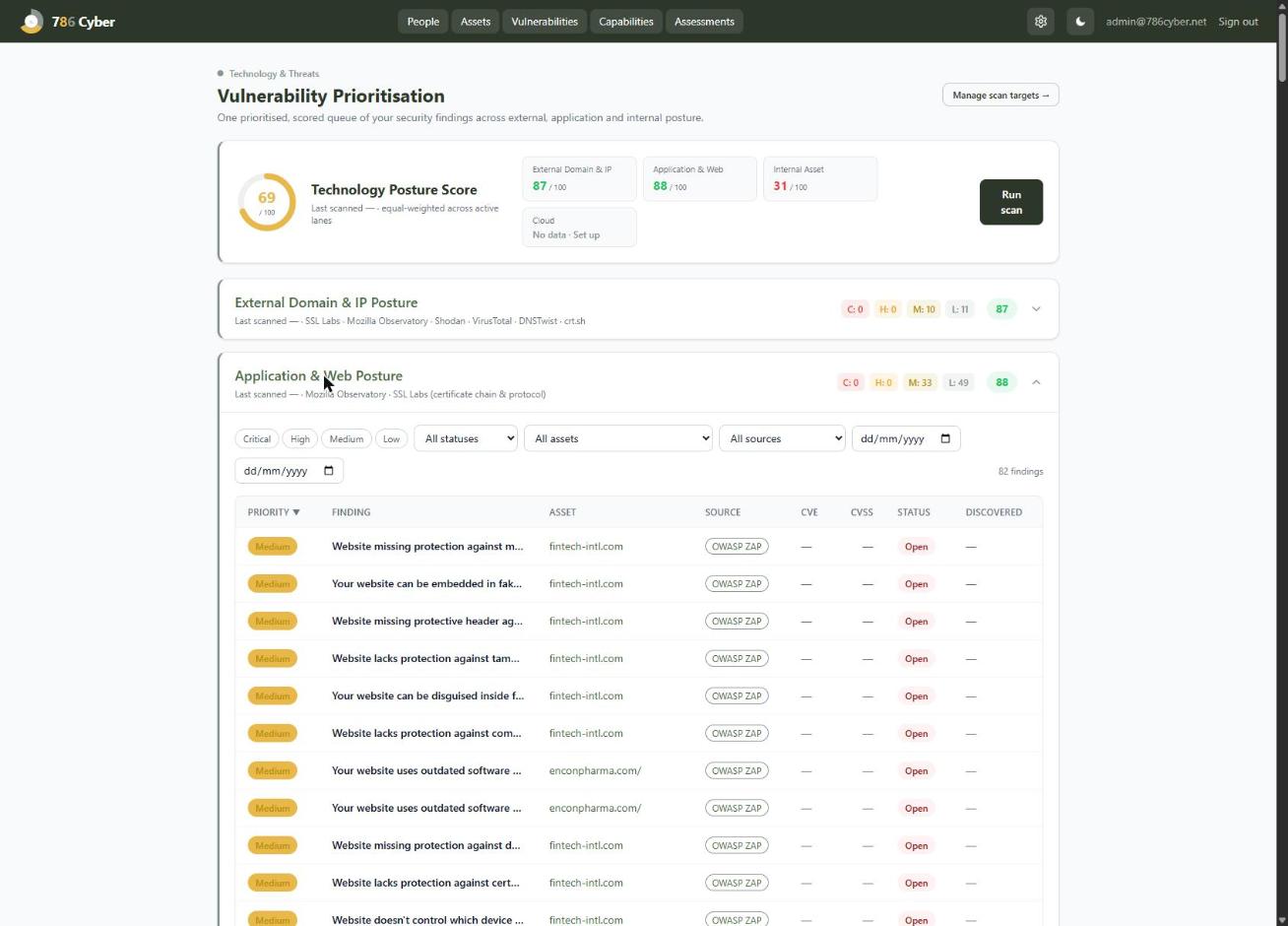
Scanning runs on OWASP ZAP (Zed Attack Proxy) — the open-source web application security scanner maintained under the OWASP Foundation, run here in baseline/passive mode.
Network & Asset Graph, Four Ways
Asset lists tell you what you have. They don’t tell you what talks to what, who has access to which system, or which single point of failure would take down the most connected part of your network. That’s a graph problem, not a list problem.
The same estate data renders four ways — by Assets (grouped by type), by People (who’s linked to what), by Network (typed connections, with the relationship labelled) and by Map (department-grouped) — with export to PNG. The Network view adds criticality-weighted risk rings, so the most critical, most connected assets are visually obvious rather than numerically ranked in a table.
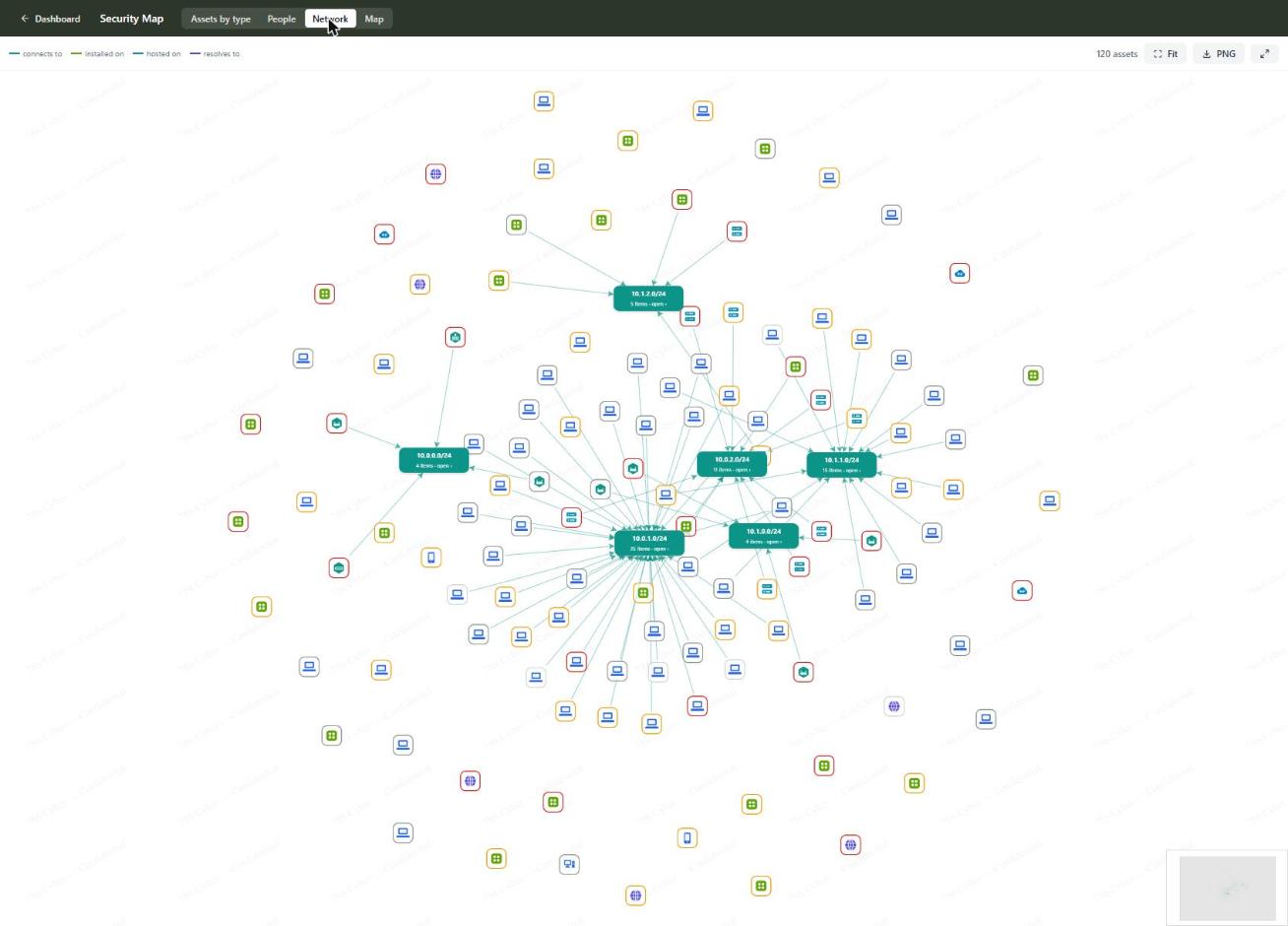
This is a relationship graph (sometimes called an asset/dependency graph) — nodes are assets or people, edges are typed relationships, and the layout is force-directed so structurally important nodes surface visually rather than requiring a manual audit.
External Threat & Exposure Monitoring
Attackers reconnoitre using public data before they ever touch your network — exposed ports, weak TLS configuration, breached credentials for sale, domains registered to impersonate your brand. All of it is visible to anyone who looks. Most businesses never look.
Continuous monitoring across your domains and IP ranges pulls from SSL Labs (certificate and protocol strength), Mozilla Observatory (header hygiene), Shodan (exposed services and ports), VirusTotal (reputation), DNSTwist (typosquat and look-alike domains) and crt.sh (certificate transparency) — plus dark web monitoring for credential exposure tied to your domains.
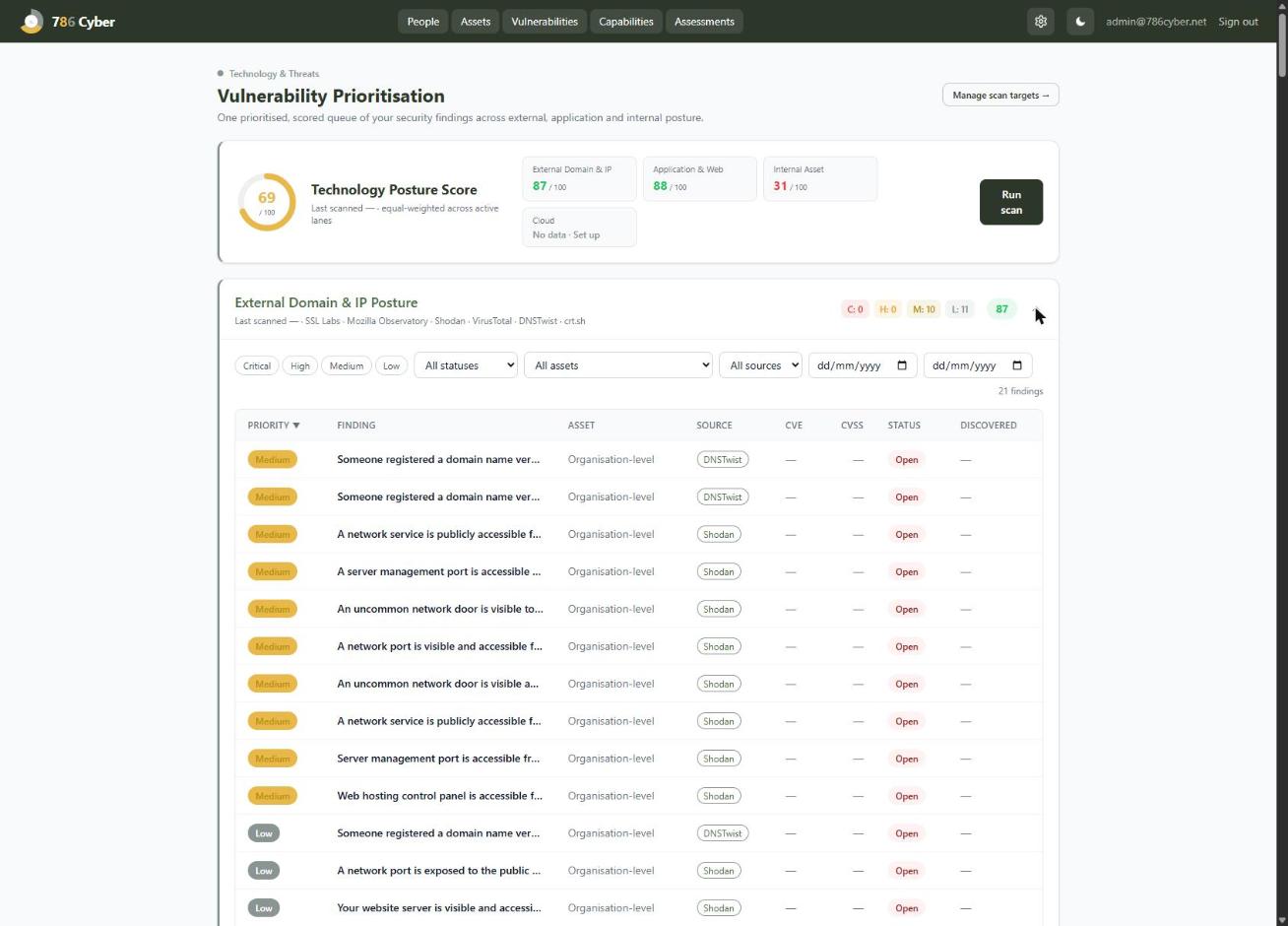
This is external attack surface monitoring combined with dark web / credential-exposure monitoring — the outside-in view of your organisation, built from open-source intelligence (OSINT) feeds rather than anything installed inside your network.
Software Inventory & SBOM
"We have a vulnerability management programme" isn’t a satisfying answer to "prove it" — customers, auditors and regulators increasingly want a software bill of materials, not a summary. Per-app CVE matching also turns "patch everything" into "patch this specific outdated package on this specific server."
Every asset’s installed software inventory is matched against CVE databases (CPE-to-NVD matching) automatically, surfaced per-asset alongside recent scan history, and exportable as a CycloneDX-format SBOM for the whole estate or a single system.
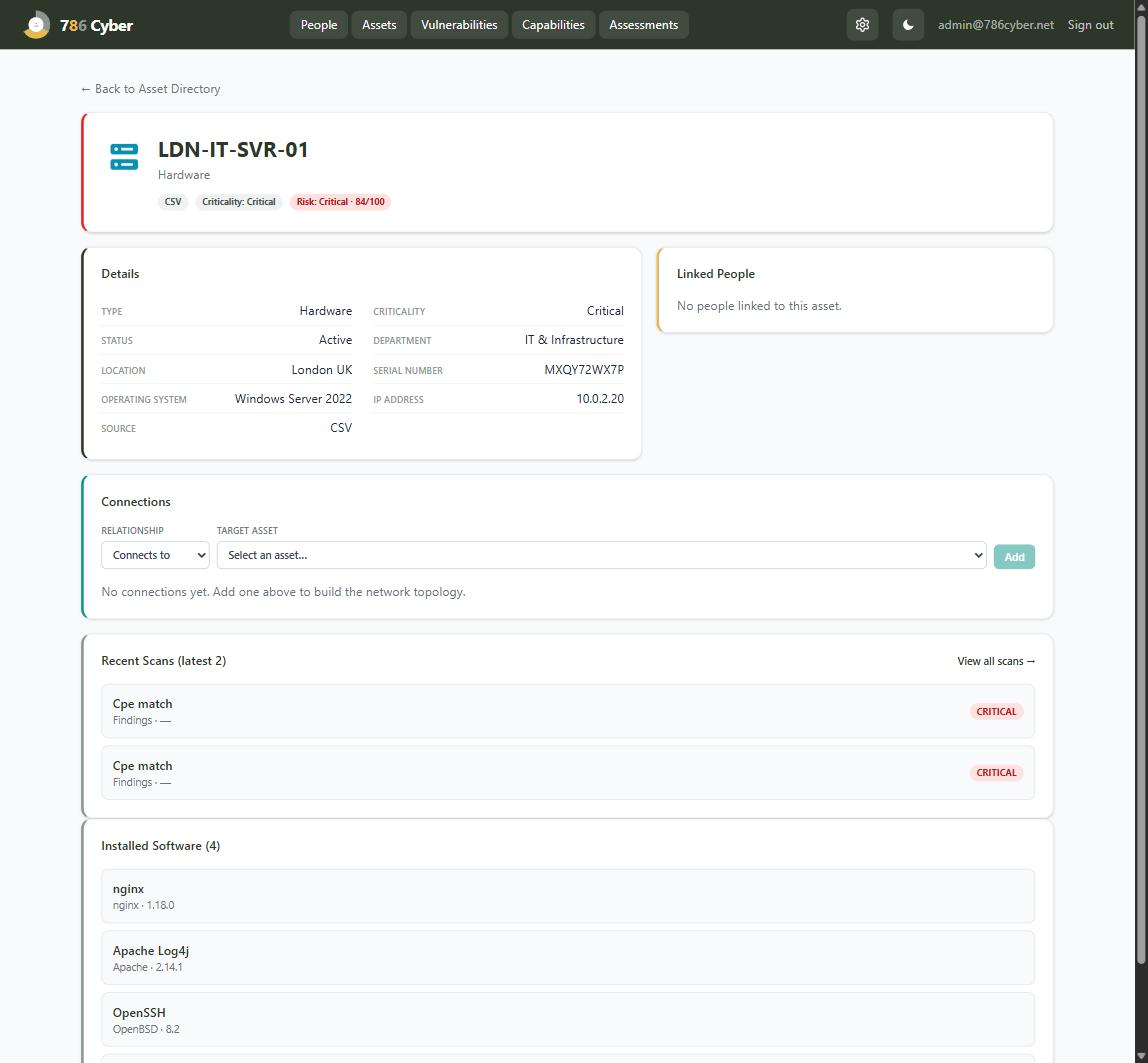
An SBOM (Software Bill of Materials) is a machine-readable inventory of every software component running on a system — increasingly required in procurement and by regulations like the EU Cyber Resilience Act. Export format here is CycloneDX, one of the two dominant open SBOM standards (alongside SPDX).
Capability Gap Analysis
Every framework ultimately depends on a much smaller set of underlying capabilities — MFA, cloud posture, web scanning, patching discipline. Answering the same question thirty different ways for thirty different frameworks is the single biggest source of compliance fatigue. Map the capability once, and every framework that depends on it inherits the answer.
Capabilities are marked Evidenced (detected from platform activity or a connected third-party tool), Unknown (not yet evidenced either way — flagged honestly rather than assumed) or Declared (documentation- or process-based). Gaps route automatically to the right fix — in-platform tooling, a documentation task, or a third-party partner — and the reverse view surfaces frameworks you’re already most of the way to satisfying.
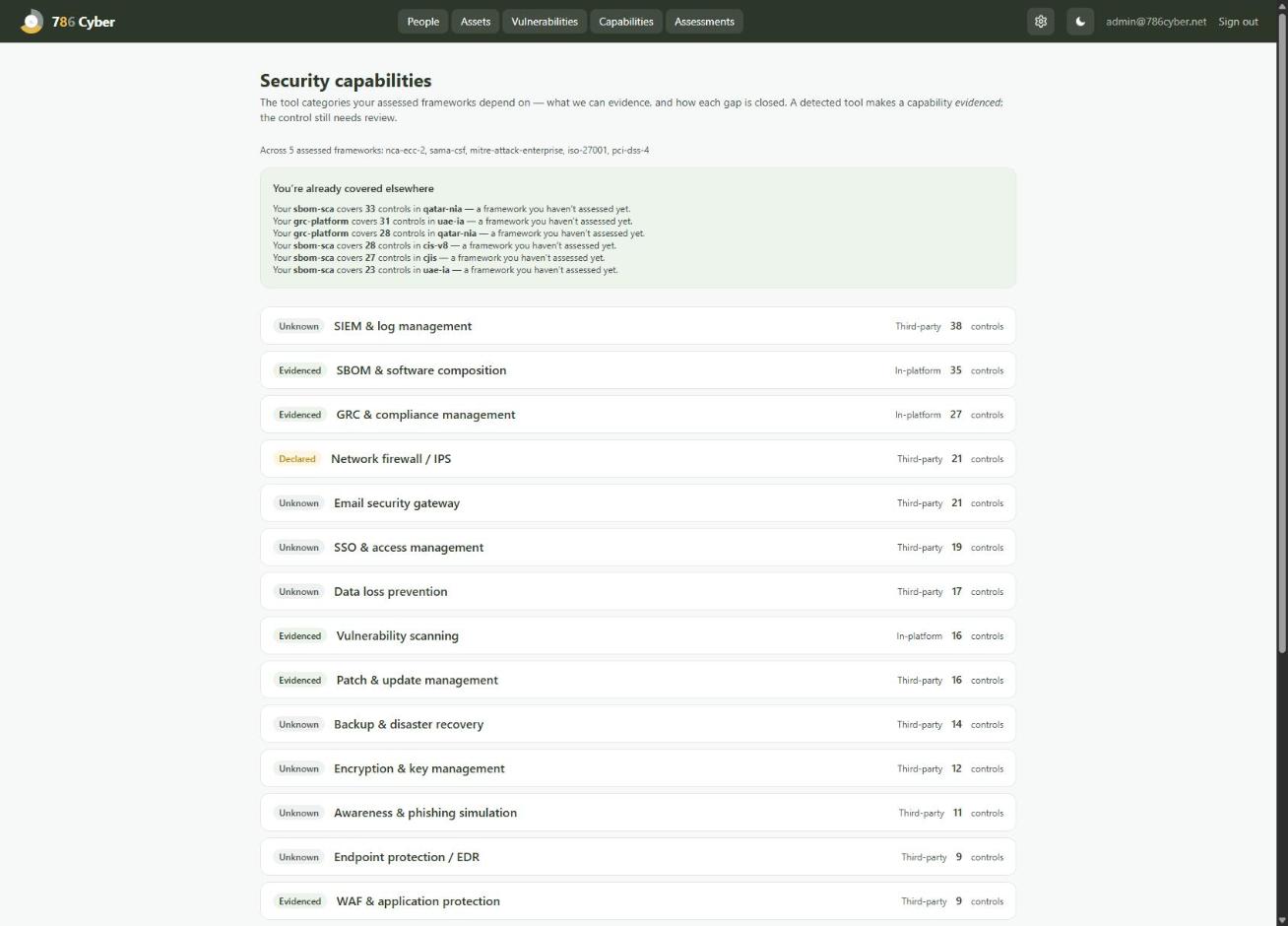
This maps frameworks → controls → canonical controls (a normalised control taxonomy shared across frameworks) → underlying capabilities, which is what makes cross-framework credit possible — one capability, evidenced once, can satisfy the equivalent control in every framework that requires it.
PDF Scan Reports
Findings that live only inside a dashboard don’t get shared. MSPs need something branded to hand a client. In-house teams need something to attach to a board update or an insurer questionnaire. A PDF export turns a live scan into a document that travels.
Every web and cloud scan exports as a branded PDF — organisation name, scan target and date, severity breakdown table, and full per-finding detail with remediation guidance and reference links, ready to share as-is or attach to a compliance submission.
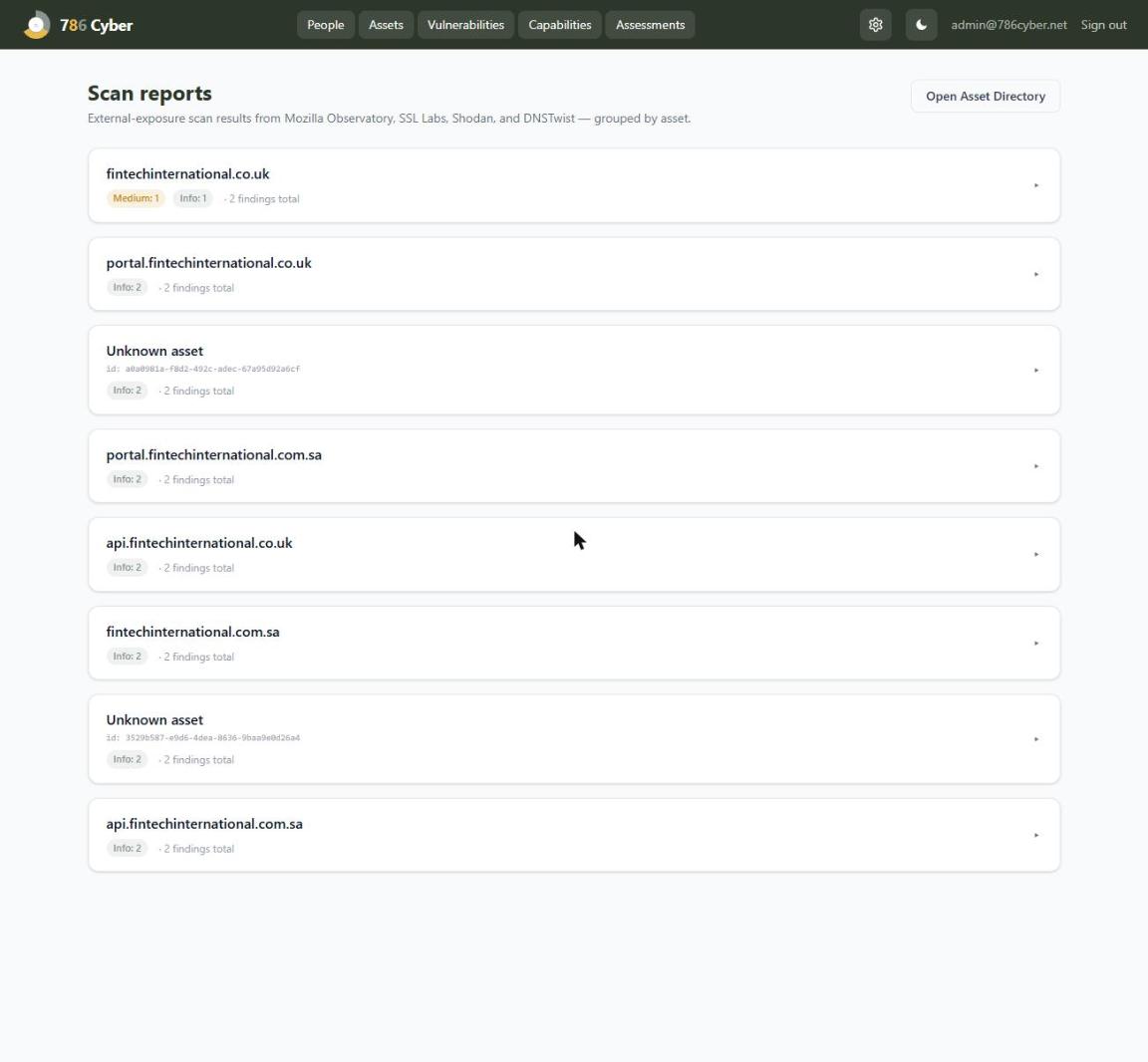
No single named standard here — this is plainly exportable, audit-ready PDF reporting; the value is the export/share workflow rather than an underlying protocol.
Framework coverage
Findings and controls from every capability on this page are tagged and mapped automatically to Cyber Essentials, Cyber Essentials Plus, ISO 27001, PCI-DSS 4.0.1, NIS2, NIST CSF 2.0 and DORA — plus the GCC frameworks covered under the Security Universe.
Patch management and malware protection both require asset visibility.
Annex A.5.9 and A.8.8 require documented asset inventory and vulnerability management.
Requirements 6, 11 and 12 require scanning, testing and a complete CDE inventory.
The Identify and Detect functions depend on asset visibility and threat monitoring.
Start free for 14 days — no card. Connect a domain and a cloud account and see real findings on day one.
Every capability on this page is included from Essentials up; CSPM and web scanning allowances scale by tier.
Pricing →£249/mo
or £199/mo billed annually
compliance, plus automation
Start free →£549/mo
or £439/mo billed annually
for a scaling security function
Start free →£1,199/mo
or £959/mo billed annually
for an established programme
Start free →Just need to get compliant? Comply from £149/mo. Larger or regulated? Enterprise from £2,500/mo — talk to us →. All prices ex-VAT.